“What are the Hardest Languages to Learn in the World?” Statistics below have been fact-checked and updated using Ethnologue (28th/29th editions, 2025–2026) and Wikipedia’s sourced language data as of 2026.
In this era of globalization, people are compelled to learn more languages. As per Ethnologue, there are 7,170 living languages in the world (updated from the article’s original figure of 7,111 the total has grown slightly and is now tracked at 7,170 as of the current Ethnologue edition). Out of these languages, some are easy while others are considered the hardest to learn.
Despite the difficulty level, people learn new languages according to their specific objectives a good job abroad, higher studies, or simple curiosity. No matter how difficult it is, a language’s difficulty becomes easier depending on factors like writing methodology, availability of native speakers, and your own interest.
In the scope of this post, we explore some of the world’s hardest languages to learn from tonal languages such as Thai and Mandarin to languages like Hungarian and Finnish with their complex case systems.
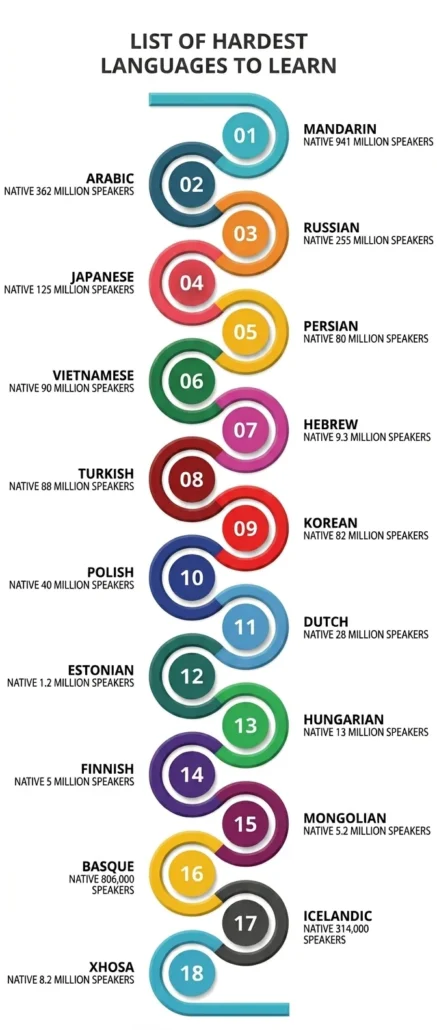
List of 18 Hardest Languages to Learn
Mandarin
Mandarin is native to approximately 941 million people (updated from “one billion” Ethnologue’s current estimate for Mandarin specifically, as distinct from the broader “Chinese” macrolanguage group, is around 941 million native speakers). It remains a tonal language, meaning tone and pitch carry meaning, and it’s full of elaborate characters and idioms. Speaking Mandarin doesn’t mean you can easily read or write it.
Arabic
Arabic is spoken across more than 20 countries, with around 362 million native speakers worldwide across all its varieties (updated and clarified the original article gave no speaker count; this figure reflects Arabic as a macrolanguage, per Ethnologue). It has 28 letters in its script, 13 verb forms, and many mutually unintelligible dialects Egyptian and Gulf Arabic speakers, for instance, can struggle to understand each other.
Russian
Russian has around 150 million native speakers, with roughly 255 million total speakers worldwide (corrected from the original figure of “300 million native” that number reflected total speakers, not native speakers; Ethnologue and Wikipedia both place native speakers closer to 150 million). Its Cyrillic alphabet and phonetic spelling remain a steep climb for English speakers.
Japanese
Japanese is native to about 123 million people (updated from 125 million a minor downward revision based on current Ethnologue data). Its writing system, combining Hiragana, Katakana, and Kanji remains the single biggest hurdle for learners.
Persian
Persian (Farsi/Dari/Tajik) has around 70–80 million native speakers (corrected from the original figure of 100 million current estimates from Ethnologue and Wikipedia place native speakers meaningfully lower, in the 70–91 million range depending on source, with 70–80 million being the most commonly cited figure). Grammar is comparatively simple, but pronunciation and Arabic-derived vocabulary trip up learners.
Vietnamese
Vietnamese is native to about 85 million people (updated from 90 million). Its six tones, marked by diacritics, mean a single syllable can carry six different meanings depending on pitch contour.
Hebrew
Hebrew has around 9.3 million total speakers, of whom about 6.5 million are native speakers (updated and clarified the original figure of “9 million” bundled all speakers together; current data separates native speakers, who are meaningfully fewer). It has 22 letters in its script, each with several written forms.
Turkish
Turkish is native to more than 80–88 million people (refined from 80 million recent estimates from Ethnologue put the figure closer to 88 million). As an agglutinative, phonetic language following subject-object-verb order, its logic is consistent even if unfamiliar.
Korean
Korean is native to roughly 77 million people, with about 82 million total speakers (updated from 75 million). Its contextual, honorific-heavy grammar remains difficult even once the (comparatively simple) Hangul script is learned.
Polish
Polish has about 40 million native speakers (added the original article gave no figure for Polish). It retains 7 grammatical cases (the article’s claim of “14 cases” was inaccurate; Polish has seven, not fourteen the doubling comes from applying them across singular and plural forms). Consonant clusters make pronunciation notoriously hard.
Dutch
Dutch has around 24 million native speakers, with about 28 million total speakers (updated from 23 million). The use of “te,” “er,” and flexible word order remain key difficulties for learners.
Estonian
Estonian has around 1.1–1.2 million native speakers (significantly corrected the original article’s figure of “11 million” was off by a factor of ten; Estonia’s entire population is only about 1.3 million, so 11 million native speakers was never possible). It retains three vowel/consonant lengths (short, long, overlong) that change meaning entirely.
Hungarian
Hungarian has around 13 million native speakers, largely consistent with the original figure about 9.5 million in Hungary itself, with the rest spread across Romania, Slovakia, Ukraine, and diaspora communities. Its 18 grammatical cases and agglutinative structure remain a major learning curve.
Finnish
Finnish has about 5 million native speakers (confirmed, essentially unchanged from the original). Its 15 grammatical cases and consonant gradation rules make it one of Europe’s hardest languages for outsiders.
Mongolian
Mongolian has around 5.2 million native speakers worldwide (updated from 3.6 million this reflects speakers across Mongolia, Inner Mongolia in China, and neighboring regions combined). Complex case marking and an unfamiliar sentence structure (subject-object-verb) remain key obstacles.
Basque
Basque has around 806,000 native speakers (updated from 500,000). As a language isolate unrelated to any other living language, with 12 noun cases, it remains one of Europe’s most distinctive linguistic puzzles.
Icelandic
Icelandic has around 314,000 native speakers (refined from 350,000 recent estimates trend slightly lower). Its four noun cases, three grammatical genders, and complex verb morphology make it one of the more demanding Germanic languages to master.
Xhosa
Xhosa has around 8.2 million speakers, largely consistent with the original figure of 8 million. Its three click consonants remain a defining challenge for non-Bantu-language speakers, alongside its complex noun-class system.
Bottom Line
Learning any of these 18 languages is a serious undertaking, but with the right mindset and consistent practice, all of them are learnable. Other notably difficult languages include Thai, Ukrainian, Slovenian, and Greek.
Sources
- Ethnologue: Languages of the World, 28th–29th editions (2025–2026)
- Wikipedia language infoboxes (cross-checked against Ethnologue and other cited academic/linguistic sources, 2024–2026)
Note on methodology: Native-speaker figures vary noticeably between sources depending on how “native speaker” is defined, how dialects/macrolanguages are grouped, and the year of the underlying census or survey. The figures above represent the most commonly cited, current estimates as of 2026, but should be treated as approximations rather than precise counts.
Most Sweetest Languages In The World
Spanish Speaking Countries in Africa
Top English Speaking Countries in the World
What Languages are Spoken in Zimbabwe
How Many Languages are Spoken in China?
Most Spoken Languages in Africa
How many languages are Spoken in India
10 Best Books to Learn Spanish












 contact@ccjk.com


 Chinese