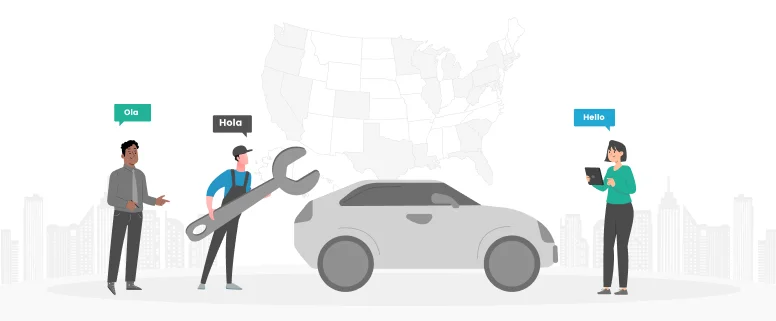
The United States is a large country where people travel long distances every day. Anyone who has traveled across the U.S. knows how much people depend on cars. Distance shapes much of everyday life in the United States. This is a country where cities are spread out and daily travel often takes time. Visiting a friend can easily mean driving 30 or 40 minutes. In many towns, a car isn’t a status symbol; it’s a survival tool. This deep-seated reliance is why the automotive industry plays a major role in the U.S. economy and US automotive translation experts play a key role in helping the industry communicate across markets.
Americans buy millions of vehicles every year. But modern vehicles are sophisticated, interconnected pieces of global technology. A car sold in a dealership in Ohio likely contains software from Seoul, sensors from Stuttgart, and battery tech from Ningbo. For this global supply chain to function smoothly for an American driver, clear language acts as a bridge.
Table of Content
-
Why Language Precision Is the New Safety Standard
-
The Iran Factor: When Geopolitics Hits the Gas Pump
-
The Electric Adaptation: A New Way of Life
-
Navigating the Complexity of Global Engineering
-
The Hidden Cost of Bad Localization
-
Why Context is King in the Auto World
-
The Road Toward 2030 and Beyond
-
Why do automotive companies in the U.S. need professional translation services?
- How does professional translation impact vehicle safety?
- What role does localization play in promoting electric vehicles?
- Can poor translation affect a company’s reputation or finances?
- How does a company like CCJK support automotive businesses in the U.S.?
Why Language Precision Is the New Safety Standard
In the old days, owner’s manuals often sat unused in the glove compartment and were forgotten about until you needed to know how much air to put in the tires. Today, many manuals are digital and built into the car’s interface. Even a minor translation mistake can cause significant confusion. Consider a warning light flashing on a dashboard during a rainstorm. If the translated message is ambiguous or uses the wrong technical term, the driver’s reaction time may be delayed. In the world of high-speed travel, unclear instructions can delay the driver’s response.
This is why “good enough” is a dangerous phrase in the auto world. Companies need more than just people who speak two languages. They need partners who can understand complex U.S. safety regulations and ensure every warning label meets strict standards.
The Iran Factor: When Geopolitics Hits the Gas Pump
It will be impossible to discuss the American car market without discussing oil. In the coming months of 2026, global markets will respond rapidly to tensions in the Middle East, particularly involving Iran. The Strait of Hormuz will remain one of the most important oil routes in the world, as a large percentage of the world’s oil will have to pass through this area. If Iran threatens to impose restrictions on this route, fuel prices will rise quickly.
For example, when gas prices jump from around three dollars to nearly five dollars a gallon in various states, consumer behavior will shift. People who would have considered large, gas-guzzling trucks will start exploring hybrid cars. Companies will need to respond to these political shifts at rapid speed. They will have to adjust marketing strategies and clearly communicate the advantages of hybrid technology. Firms that fail to show the cost-saving benefits of these new vehicles to consumers will lose market share to competitors.
The Electric Adaptation: A New Way of Life
The revolution in electric vehicles in the U.S. is perhaps the biggest change in American driving habits in decades. It is not just a new power engine; it is a completely different way of life. For Americans, a concern commonly known as “range anxiety.” This is the fear of being stranded in the middle of nowhere with a dead battery and being far from any source of help. Overcoming the fear of range anxiety is all about the use of effective communication. Drivers are slowly adapting to a different refueling pattern. Rather than refueling once a week at the gas station, people are now refueling their vehicles at home.
This change requires clear instructions about charging equipment and installation. Modern EV drivers rely heavily on in-car navigation to find high-speed chargers, making the localization of maps and real-time data crucial. Since EVs get “over-the-air” updates like a smartphone, owners have to learn how to manage software patches that actually change how their car drives.
Navigating the Complexity of Global Engineering
Building a modern car requires global collaboration. The engineering teams for a single model might be spread across three continents. They are sharing CAD drawings, safety test results, and assembly line instructions. If a manufacturing plant in Alabama misinterprets a technical spec sent from a design house in Europe, the results can be a multi-million dollar recall.
Professional translation ensures that technical instructions remain accurate across languages. It’s about units of measurement, safety tolerances, and material science. When the stakes involve thousands of pounds of moving machinery, there is zero tolerance for errors in translation. CCJK translation services are well-known for supporting these complex automotive projects. With over two decades of experience, they understand that a car manual is a technical blueprint that must be understood by everyone from the factory floor to the suburban driveway.
The Hidden Cost of Bad Localization
Many companies make the mistake of thinking they can reduce costs by using generic translation tools or non-specialized agencies. In the short term, costs may appear lower. In the long term, the costs are staggering. A poorly translated marketing campaign can alienate a specific demographic, making the brand feel “foreign” in a bad way. In a diverse country like the U.S., where Spanish is the primary language for millions, failing to provide high-quality localized content is missing significant market opportunities.
Beyond sales, there is the legal side. The U.S. is one of the most litigious markets in the world. If a consumer claims they were injured because an instruction was unclear or a safety warning was poorly phrased, legal investigations often review whether the translation was accurate. Investing in professional, human-led localization is effectively an insurance policy for a brand’s reputation and its bank account.
Why Context is King in the Auto World
One of the biggest hurdles in automotive translation is the fact that the automotive terminology changes rapidly as technology develops. Ten years ago, we didn’t talk about “regenerative braking” or “bidirectional charging.” Today, these are standard terms. A translator who isn’t embedded in the industry might produce a literal translation that creates confusing wording that confuses the customer.
True experts look at the context. They know that a “trunk” in the U.S. is a “boot” in the UK, but they also know that for a new EV, it might be a “frunk” (front trunk). They stay on top of these cultural and technical shifts so the manufacturer doesn’t have to. This cultural nuance is what makes a car feel like it belongs in an American garage. It makes the technology feel accessible and the brand feel trustworthy.
The Road Toward 2030 and Beyond
As we move further into late 2026, this automobile world will only become more complex. It’s a world in which we will be surrounded by autonomous driving features, hydrogen fuel cells, and even more integrated digital systems. It’s a world in which the automobile becomes an extension of our digital lives, a world in which we take meetings, enjoy entertainment features while parked, and control our homes.
For automobile companies to succeed in this new world of America, they must focus on their communication strategies. Whether it’s responding to a sudden oil crisis because of tensions in Iran or explaining the differences in a new battery technology such as solid-state batteries, communication will be key in determining winners and losers.
This is because the US market is just too big and too important to get the language wrong. Handling both heavy machinery and fast-moving software takes a careful, skillful approach. By working with the US automotive translation experts, car makers can rest assured that no matter how far the road may go, their message gets through loud and clear, their drivers stay safe, and their brand becomes an integral part of the daily lives of American citizens.
FAQs
1. Why do automotive companies in the U.S. need professional translation services?
The automotive industry is highly globalized. This is due to the different components of the car’s software coming from multiple countries. Accurate translation helps in understanding the specifications of the vehicle so that users can use the car optimally.
2. How does professional translation impact vehicle safety?
Modern vehicles display complex messages on dashboards and integrate digital manuals. Misunderstood translations can delay driver reactions or cause misuse of technology. Professional translation ensures instructions are precise, reducing risks and meeting U.S. safety standards.
3. What role does localization play in promoting electric vehicles?
Localization helps EV drivers understand charging procedures, software updates, and navigation for high-speed chargers. Clear, context-aware communication helps consumers adopt EV technology confidently.
4. Can poor translation affect a company’s reputation or finances?
Buying a car requires a one-time large investment. Poor translation can hinder the sales of the automotive companies. Moreover, if they buy it, inaccurate translation can lead to brand damage and legal complexities.
5. How does a company like CCJK support automotive businesses in the U.S.?
CCJK has a pool of native translators that are not only proficient in linguistics, but they are also subject matter experts in their fields. Many top-notch automotive companies are taking CCJK translation services. Whether it is technical manuals, safety documentation, or marketing campaigns, they provide seamless translation services that resonate with the USA market.














 contact@ccjk.com


 Chinese