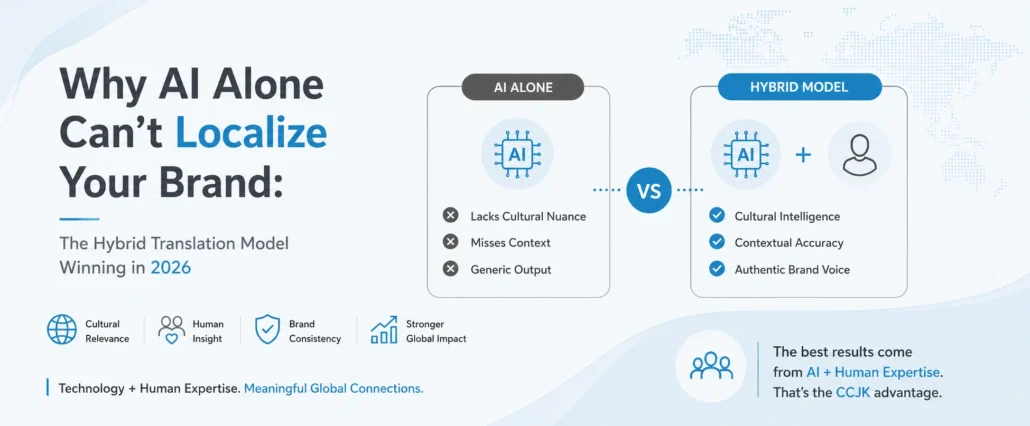
If you’ve searched for translation services lately, you’ve probably noticed the conversation has shifted. It’s no longer “should we use AI translation?”
It’s “How do we combine AI and human expertise without losing quality, brand voice, or search visibility?”
That question is the single biggest trend shaping the language services industry in 2026, and it’s reshaping how smart businesses approach global content.
Table of Content
AI Handles the First Draft. Humans Handle What Matters.
Large language models can now produce a fast, fluent first-pass translation of almost anything UI copy, marketing pages, product descriptions even entire manuals. That’s not controversial anymore; it’s simply how modern localization workflows start.
What is changing is the role of the human linguist. Translators are no longer just correcting individual sentences. Increasingly, they act as quality supervisors: reviewing AI output at a systemic level, catching patterns of error before they multiply across hundreds of pages, and protecting the cultural nuance, tone, and intent that machine output still gets wrong, especially in regulated industries like legal, medical, and finance, where a single mistranslated clause can carry real consequences.
The businesses getting the best results in 2026 aren’t the ones asking AI to do everything, and they aren’t the ones ignoring AI either. They’re the ones building a workflow where AI delivers speed and volume, and trained human linguists deliver accuracy, accountability, and brand consistency.
Localization Is Moving Upstream
Another shift worth paying attention to: localization used to be the last step before a product or campaign launched. Translate the finished content, ship it, move on.
That’s no longer how competitive companies operate. Product, marketing, and localization teams are now working in parallel from day one so that multilingual versions launch alongside, not months after, the original.
This “localization-first” approach isn’t just faster; it tends to produce content that feels native to each market instead of visibly translated, which builds more trust with international customers.
For companies with a translation memory, glossary, or style guide already in place, this shift is far easier. Those assets aren’t just internal documentation anymore; they directly shape how well AI tools perform when generating first-draft content in your brand’s voice.
The New Frontier: Getting Found in AI Search Results
Here’s the trend that’s easiest to miss but arguably the most important for 2026: visibility in international markets is no longer just about search engine rankings.
It’s increasingly about whether your localized content gets surfaced in AI-generated answers, AI overviews, chat-based assistants, and other AI search experiences that are becoming a primary discovery channel in many regions.
That changes what “good localization” even means. Translated content now has to be structured and phrased in a way that aligns with how AI systems interpret relevance and answer questions in each target language, not just translated word-for-word from the source. In practice, this means:
- Adapting topics and structure to match how questions are actually asked in the local market, not just translating the original article
- Ensuring multilingual content is technically accessible to AI crawlers and search systems
- Treating localization as part of your discoverability strategy, not a separate task that happens after content is “done”
Companies that treat translation purely as a linguistic exercise, swapping the words keep everything else the same, are starting to lose visibility to competitors who treat it as part of their growth strategy.
Multimedia and Accessibility Are No Longer Optional
Text-only localization is quickly becoming the exception rather than the rule. Video, audio, and interactive content now make up a growing share of what businesses need translated, and audiences increasingly expect that content to be fully accessible, subtitles, captions, dubbing, and voiceovers included, not as an afterthought but as a standard deliverable.
This is especially true for product demos, training content, and e-learning material, where a purely text-based translation no longer meets user expectations.
What This Means for Your Business
If you’re planning to expand into new markets in 2026, a few practical takeaways:
1. Don’t treat AI and human translation as competing options. The winning workflow uses both AI for speed and scale and human linguists for accuracy, nuance, and accountability.
2. Build your localization plan before your content is finished, not after. Involving translators early leads to faster, more authentic multilingual launches.
3. Invest in translation memories and glossaries. They improve both human and AI output quality over time, and they’re a real competitive asset.
4. Think beyond text. If your content strategy includes video, audio, or interactive elements, your localization strategy needs to as well.
5. Localize for discoverability, not just accuracy. How your content performs in AI-driven search matters as much as whether it reads naturally.
How CCJK Can Help
At CCJK, we’ve spent more than two decades helping businesses communicate across 230+ languages, and we’ve built our workflow around exactly this hybrid model: fast, AI-assisted first drafts paired with experienced native-speaking linguists who understand your industry, your audience, and your brand voice. Whether you need document translation, software and app localization, multimedia and subtitling, or a full localization strategy built into your product roadmap from day one, our team is ready to help you expand into new markets without losing quality along the way.
Ready to make your content work across languages and markets? Get in touch with our team to talk through your localization needs.












 contact@ccjk.com


 Chinese