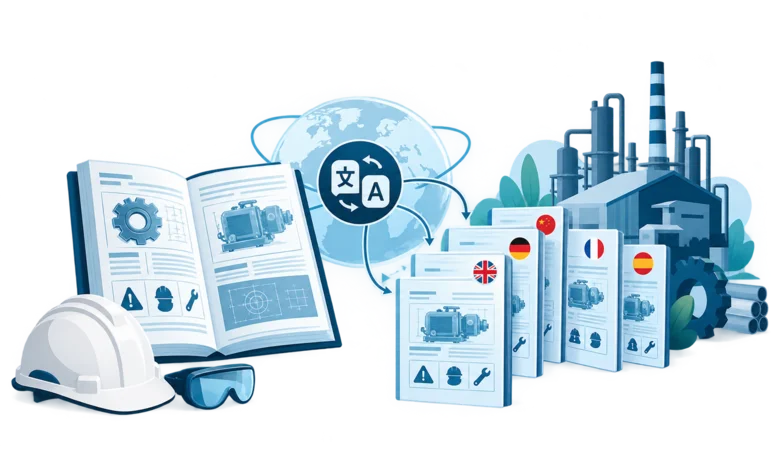
A translated manual that reads badly is an annoyance. A translated safety warning that reads badly is a risk. When an operator on a factory floor misreads “do not open while energized,” the consequences are not a bad review. They are injuries, downtime, and liability.
That is why localizing technical manuals and safety documentation is a different discipline from general translation. This guide explains what makes industrial documentation special, the practical steps that keep it accurate, and why 2027 is a deadline worth planning for now.
Why industrial documentation is different
Industrial content combines three things that rarely appear together in other kinds of writing.
Precision. Torque values, tolerances, part numbers, and step order all have to survive translation exactly. A shifted decimal or a reordered step can change the outcome of a procedure.
Consequences. Safety instructions exist to prevent harm. Their wording is often tied to legal duties, so a weak translation can create exposure for the manufacturer as well as danger for the user.
Complexity of format. Manuals contain diagrams, callouts, tables, labels, exploded views, and warnings that must sit in exact places. The words are only part of the job.
Documents that typically fall into this category include:
- Operating and user manuals
- Installation and commissioning guides
- Maintenance and service manuals
- Safety data sheets and safety instructions
- Lockout/tagout and standard operating procedures
- Product datasheets and specifications
- Training materials for operators and technicians
Step 1: Clean up the source before you translate
Localization quality is capped by source quality. Ambiguous English becomes ambiguous Japanese, Arabic and German, and each language interprets the ambiguity differently.
Before sending a manual for translation, check for:
- Long, layered sentences. Break them into single instructions.
- Inconsistent terms. If the same part is called a “cover,” “lid” and “guard” in three chapters, translators may render three different parts.
- Unclear pronouns and references. “Remove it before starting it” leaves the reader guessing.
- Idioms and shorthand. Plain, controlled language travels best.
Many industrial teams use a simple style guide, sometimes called controlled or simplified language, to keep source text short and consistent. Even a light version pays off across every language you add.
Step 2: Build a terminology base first
Terminology is the backbone of technical localization. A glossary approved before translation begins prevents the most expensive kind of error: the one repeated across hundreds of pages.
A useful industrial glossary includes:
- Product and component names, with part numbers where relevant
- Preferred and forbidden terms
- Standard phrases for recurring instructions (for example, “disconnect from power”)
- Approved wording for every warning message
- Abbreviations and how each one should be handled per language
Approved warning text deserves special attention. Where your safety wording has been reviewed by legal or compliance teams, the translated versions should be reviewed the same way, then stored as fixed, reusable text so the same warning is never re-translated differently.
Translation memory adds a second layer of consistency. Once a sentence has been approved in a language, it is reused, which also lowers cost on updates.
Step 3: Treat warnings as their own category
Safety messages should not be handled like body text. Four issues come up repeatedly.
Signal words and hazard levels. Words such as danger, warning, and caution carry defined levels of severity in many safety conventions. Each target language needs equivalents that keep the same ranking, and the choice should be documented in the glossary.
Symbols and pictograms. Graphical safety symbols are designed to reduce reliance on text, and international conventions exist for them. Check which symbols are required in each market, and whether text embedded in graphics needs replacing.
Tone and mood. Warnings should be direct and unambiguous. Some languages default to polite or indirect phrasing that softens an instruction. A trained technical linguist knows when to keep the command form.
Placement. A warning belongs before the step it applies to, not after. Different sentence structures can push the critical word to the end of a line, so layout and wording need to be checked together.
Step 4: Handle units, numbers and formats explicitly
Manuals fail quietly on small details. Decide in advance how each market should show:
- Units of measure (metric, imperial, or both)
- Decimal and thousands separators
- Date and time formats
- Currency, where relevant to spare parts or service contracts
- Temperature, pressure and torque conventions
- Voltage, frequency and plug or connector standards
Never assume that converting a number is the translator’s default job. Agree the rule in the project brief, and have it checked by someone who understands the equipment.
Step 5: Plan for layout, fonts and text expansion
Words in different languages take up different amounts of space. German and Finnish often run longer than English, while Chinese, Japanese, and Korean can be more compact but need different fonts and line-breaking rules. Arabic and Hebrew read right to left, which affects tables, callouts, and numbered steps.
This makes desktop publishing a core part of the workflow, not an afterthought. Good practice includes:
- Giving translators and layout specialists access to the source design files, not only a PDF
- Testing that translated text fits in tables, labels, captions, and callouts
- Confirming that fonts support every character in the target language
- Keeping callout numbers, part labels and figure references aligned with the diagrams
- Checking that page numbers, tables of contents and cross-references still work
CCJK’s technical localization service includes layout adjustments so translated content fits within the format of the original document, whether that is a PDF manual, an online help system or a mobile app.
Step 6: Use subject-matter linguists and independent review
For industrial content, native fluency is necessary but not enough. The translator also needs to understand the equipment. Someone who has never seen a hydraulic system can produce grammatical sentences that make a mechanic wince.
A dependable process has at least three layers:
- Translation by a native speaker with experience in the relevant field, such as engineering, automotive, manufacturing or electronics.
- Independent review by a second qualified linguist who checks accuracy, terminology and completeness against the source.
- Final quality checks for numbers, units, formatting, and consistency.
For high-risk documents, add a fourth layer: in-country review by an engineer or safety officer at your local office or distributor. They will catch details that only someone using the equipment daily would notice, such as a regional name for a tool.
Machine translation can help with speed on some low-risk content, but for safety-critical text a human expert must own the result. If you are considering it for parts of a large manual set, decide which sections qualify and which do not, and document that decision.
Step 7: Keep every language in sync as products change
Products get revised. Firmware updates, part changes, and new safety findings all change the documentation, and the more languages you support, the easier it is for versions to drift apart.
To avoid that:
- Identify one source-of-truth document for each product version
- Track changes at sentence level, so only what changed is re-translated
- Use translation memory so unchanged text is reused automatically
- Keep a clear record of which language versions match which product releases
- Retire old versions deliberately, so field teams never work from outdated instructions
For manufacturers with large catalogs, a translation management system can automate much of this and keep an audit trail. That trail is valuable evidence if regulators or customers ask how a warning came to read the way it does.
Why 2027 matters if you sell machinery in Europe
If you place machinery on the EU market, a major rule change is close. The EU Machinery Regulation (Regulation (EU) 2023/1230) replaces the Machinery Directive and applies from 20 January 2027. That is less than four months away at the time of writing, and machinery placed on the market before that date generally stays under the older rules.
Points that matter for documentation and localization:
- Language. Instructions, safety information, and the declaration of conformity must be provided in a language that users can easily understand, as determined by the country where the machine is placed on the market. In practice, this usually means the official language or languages of each market.
- Digital instructions. The regulation allows instructions to be supplied digitally, provided users can find, access, and download them, and are told how. Paper copies remain available on request.
- Long-term availability. Digital instructions need to stay accessible for years, which affects where and how you host multilingual manuals.
- Non-EU manufacturers. The rules apply to machinery sold into the EU regardless of where it is made.
This is an overview, not legal advice. Your compliance team or a qualified adviser should confirm exactly which obligations apply to your products. But from a localization point of view, the practical consequences are clear: audit which markets you sell into, confirm you have every required language, and make sure your workflow can update all versions together.
A practical checklist before you send a manual for translation
- Have we cleaned and simplified the source text?
- Do we have an approved glossary, including fixed warning wording?
- Have legal or compliance teams approved the safety messages?
- Have we agreed rules for units, numbers, dates, and symbols per market?
- Can the translation team access editable design files?
- Do translators have relevant subject expertise, and is there an independent review?
- Is an in-country technical review planned for high-risk content?
- Do we have a process for updating all languages when the product changes?
- If we plan to publish digitally, where will manuals live and how will users reach them?
How CCJK supports industrial documentation
CCJK provides technical and manufacturing translation across 230+ languages, with linguists who are native speakers and subject-matter experts in fields including engineering, automotive, manufacturing and electronics. Our work covers user manuals, installation guides, maintenance guides, safety manuals, and product datasheets, delivered through ISO-certified processes with layout adjustments so your translated documents fit the original format.
You can explore the relevant services here:
- Technical translation services
- Manufacturing translation services
- Safety manual translation
- User manual translation
- Installation guides translation
- Maintenance guides translation
Frequently asked questions
What is the difference between translating and localizing a technical manual?
Translation converts the words. Localization also adapts units, formats, symbols, regional terminology, layout, and references so the manual works correctly for users in a specific market.
Which manuals need the highest level of review?
Any document where a misunderstanding could cause injury or damage: safety instructions, operating procedures for hazardous equipment, maintenance and lockout procedures, and warnings on labels and screens.
Can we use machine translation for technical manuals?
For low-risk internal content, sometimes, followed by human editing. For safety-critical text, a qualified human expert should own the translation and review. Decide by content type and document the decision.
How do we keep translated manuals consistent across product updates?
Use an approved glossary, translation memory, and a change-tracking process so only changed sentences are retranslated and every language is updated together.
Do the new EU machinery rules affect translation?
They can. Instructions and safety information must be available in a language users in each destination country can easily understand, and digital delivery introduces requirements on access and availability. Confirm the details for your products with a compliance adviser.
Get your documentation ready
If you are preparing manuals for new markets, or checking whether existing language versions are ready for 2027, send us a sample chapter. We will review it, flag potential risks, and recommend a workflow that fits your content and your timeline. Request a free consultation to get started.










 contact@ccjk.com


 Chinese